A Survey of the Western Mesara Plain in Crete
https://escholarship.org/uc/item/9b59z1np
This publication is dedicated to the people of the Mesara and Joseph and Maria Shaw (excavators of Kommos, the site to which these brief excerpts attempt to provide a greater focus and understanding.) Access to the full pdf of this preliminary report is available through the url above. For improved accessibility of PDF content, download the file to your device. – James C Stratis
By Vance Watrous
Page 227
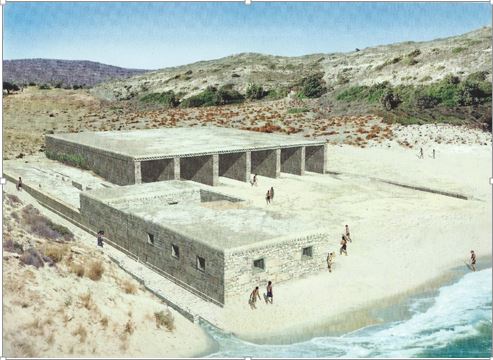
“On the coast at Kommos, a large, walled port complex, supplied with a harbormaster’s residence (?), an open court, shipsheds, workrooms, and storage magazines, was constructed in Late Minoan I.77 This port was probably built by and under the central control of the palace at Phaistos or even ultimately Knossos. The port had widespread commercial contacts with the Cyclades, the Greek Mainland, Anatolia, Cyprus, the Levant, and Egypt.78 Outside the enclosed port complex were blocks of houses, smaller and less pretentious than contemporary houses at Tylissos, Palaikastro, or Zakros. Phaistos, Agia Triada, and Kommos seem to have had distinct, complementary roles in the region during the Late Minoan I period.“
- 77 See Shaw 1984.
- 78 Kommos III.
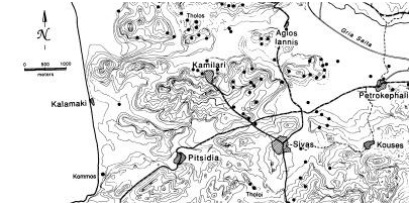
“Very few sites of the succeeding Late Minoan IIIC period (ca.1200-1000 B.C.) were found by the survey. Apparently the countryside was nearly abandoned during this period. The three Late Minoan IIIC sites discovered were a settlement (B 38) and its cemetery (B 37) south of Sivas and a gravesite on the slope of Ieroditis northeast of Phaistos. The settlement (B 38), occupied from Middle Minoan I to Late Minoan III, yielded a scatter (80 x 110 m.) of Late Minoan IIIC monochrome sherds and cooking ware. At the base of this settlement, the associated cemetery (70 x 70 m.) produced bones, ash, larnakes, kraters, monochrome bowls, tripod offering tables, and snake tubes. In the Western Mesara, Late Minoan IIIC pottery is also known from the excavated sites at Liliana, Agia Triada, Kommos, and Phaistos. Liliana, southwest of the village of Kalivia, is the site of a cemetery where eighteen larnakes from eight tombs were recovered in excavation.87 The settlements at Agia Triada and Kommos were abandoned in the second half of the 13th century B.C., although a shrine at Agia Triada was visited by worshipers during Late Minoan IIIC.88 Little of the Late Minoan IIIC material found at Phaistos has been published, so the size of the settlement at this time remains uncertain. Rural depopulation elsewhere in Crete at this time suggests that the population in our survey area may have been centralized at Phaistos during LM IIIC.89
- 87 Liliana tombs: Savignoni 1904 and Kanta 1980, p. 100.
- 88 See Banti 1941-1943; D’Agata in press. Kommos shrine: Shaw 1984, pp. 279-284 and pls. 53-60.
- 89 This pattern of rural abandonment in LM IIIC Western Mesara is matched in other areas of Crete where the coastal plain is deserted for hill- or mountain-top settlements, such as Vrokastro and Kavousi. See Hayden 1983; Gesell, Day, and Coulson 1988. “
Shaw 1984, pp. 279-284 and pls. 53-60. 89 This pattern of rural abandonment in LM IIIC Western Mesara is matched in other areas of Crete where the coastal plain is deserted for hill- or mountain-top settlements, such as Vrokastro and Kavousi. See Hayden 1983; Gesell, Day, and Coulson 1988. “
The author Livingston Vance Watrous of these excerpts and the entire original report also authored Kommos associated content in Kommos III and The Plain of Phaistos JCS